When I was younger, my favorite painting was The Building of FTL1 by John Harris:
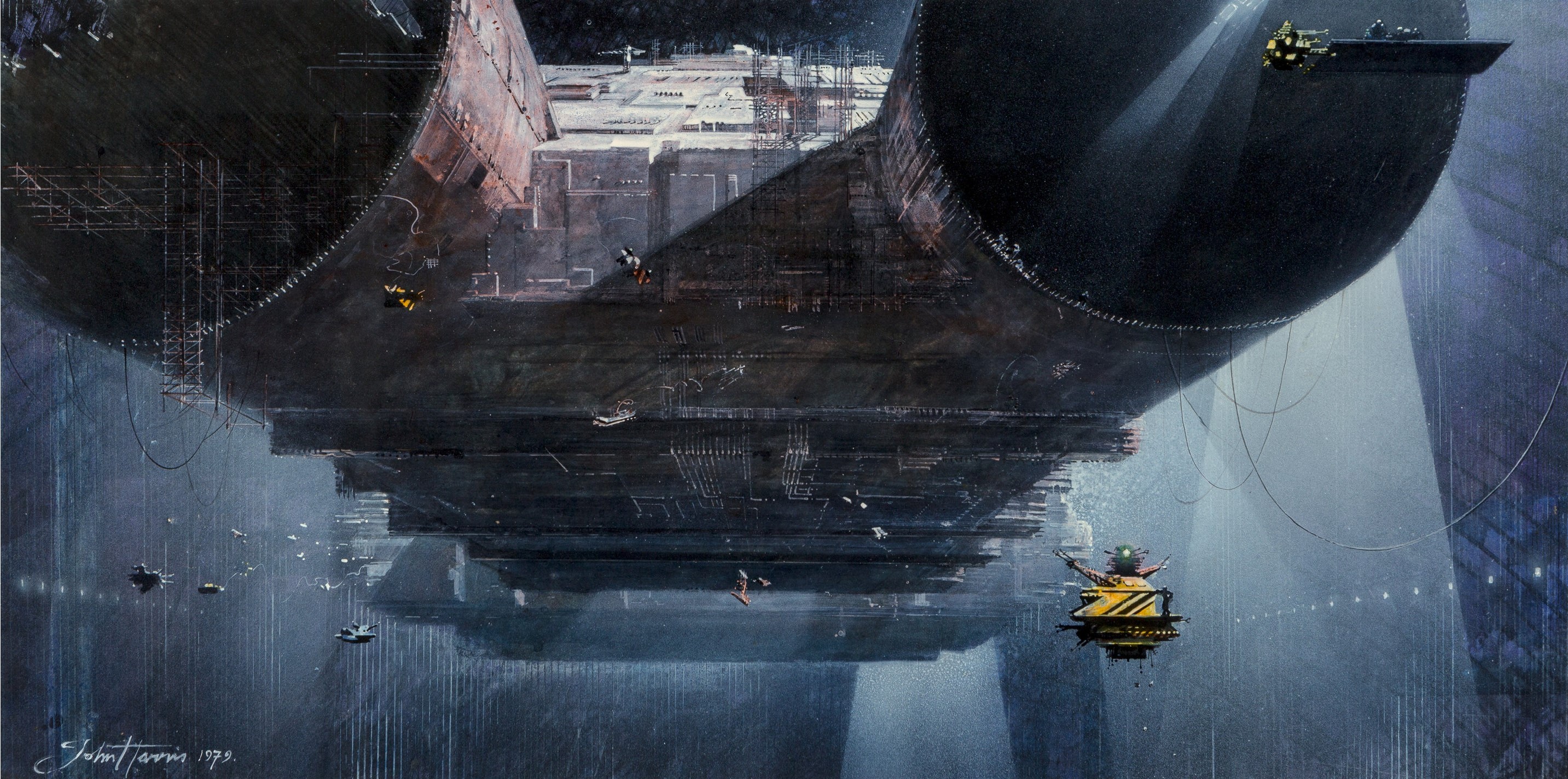
Looking back, I think what captivated me wasn’t the painting itself, but the feelings of awe and wonder that it evoked in me. In philosophy this phenomenon is called the sublime.
The sublime occurs when the imagination reaches its limits. When we can’t fully picture what we’re confronting, what’s left is a lingering feeling rather than a clear thought.
Dread
The trouble with the sublime is that it cuts both ways. We can bask in the warmth of wonder, or shiver in the chill of dread.
As software engineers, we’re facing a lot of uncertainty. AI lab leaders are implying that our professional skills are going to be redundant soon. At work we’re being asked to supervise coding agents to do the job we used to do. But the worst part is the open-endedness of it all. We don’t know how much better AI will get. The possibilities overwhelm our imagination, and we’re left with this lingering dread.
In other words, AI doesn’t frighten us simply because it’s powerful, but because it is indeterminate.
Virtue
Should we lean in to it?
According to Xenophon, when Socrates was asked why he tolerated his quarrelsome wife Xanthippe, Socrates replied:
I follow the example of the rider who wishes to become an expert horseman: “None of your soft-mouthed, docile animals for me,” he says; “the horse for me to own must show some spirit”: in the belief, no doubt, if he can manage such an animal, it will be easy enough to deal with every other horse besides.
At first glance, Socrates seems to offer the advice we need. Xanthippe’s difficult personality wasn’t something to endure, but an opportunity to cultivate virtue. Perhaps “AI” affords us the same opportunity?
Unfortunately, I don’t think the analogy holds. Xanthippe was a particular person. She wasn’t an abstraction, but an inconvenience.
“AI” isn’t like that. It’s not one thing, but a shifting collection of headlines, fears and possibilities. There is no stable object to lean in to. It isn’t the coding agent on our laptop that’s making us anxious. It’s the endless imagined scenarios attached to the word “AI”. The specter grows because we can always complete the picture differently.
Reality
My mother was dead, but we had still duties which we ought to perform; we must continue our course with the rest, and learn to think ourselves fortunate whilst one remains whom the spoiler has not seized.
— Mary Shelley, Frankenstein
I have found that the best antidote for the abstract is the concrete. When I catch myself spiraling over “AI”, I do something very mundane—I go over my to-do list.
What if AI replaces me?
The recycling goes out tomorrow.
What if coding disappears?
I should buy milk.
What if this is the end of software engineering?
That closet door hinge needs greasing again.
It sounds ridiculous, but it works.
“AI” invites us to inhabit hypothetical futures. The to-do list brings us back to the present. The antidote to indeterminate fear isn’t hope, but attending to what’s in front of us.
AI is changing software engineering and upending our economy. But none of that exempts us from our current obligations.
I should buy milk.
Tags: artificial-intelligence